Publishing Retrospect
I am no longer involved in publishing books (and nor book distribution). What I chose to call Citizen Initiative is now an internet project. The remarks below are retrospective.
CONTENTS KEY
- Resisting the internet
- Citizen philosophy versus big business
- Self-publishing and Third Party
- Citizen initiative versus sectarian polemic
- Different types of publishing
- Spells win against critical observations
- Waterstones commercial policy
For many years I resisted internet exposure of any kind, preferring a low profile career. I did not believe in the contemporary elevation of persona, disliking pictorial promotions. Images of authors were not mandatory in publishing. I was here influenced by the attitude of academic press, which viewed such images as being in the bad taste of commercial publishers. One could look at hundreds of academic books, and not find one photograph of an author, however elevated the entity. Cambridge and Oxford were quite unrelenting in this respect. I also admired the more antique aversion of Plotinus to portraiture, a trait which the biographer Porphyry documented some seventeen centuries ago. That stern aspect of European temperament is largely alien today, indeed almost extinct.
My image did not appear in any of my books, and only became visible on the web in 2007. That was twenty-four years after my first book was published. Visual identity evidently makes a difference; people feel reassured that the author does actually exist, and is not a martian. Of course, on the web these days, there are so many strange presences who exult in pseudonyms and other forms of anonymity. One must therefore respect the need for clear identity in any serious undertaking.
The internet is a very different medium to book publishing, being described as a "lawless jungle" by some critics of contemporary idiom and promotion. Books are reviewed on Amazon by entities like Magic Rat. Wikipedia is certainly not exempt from accusations of identity obscurantism. The who's who of the internet has many blanks. Some sceptics argue that photographic identity should be a requirement for all website and blog contributors; moreover, all entries on Google Search should be accompanied by the real name of the composer. I have complied with these critical stipulations.
I did not become a web presence until August 2007. I loathed (and still do) many aspects of internet presentation. The preoccupation with commercial ads and animation devices does not appeal to me. Those flotsam are absent from my sites. For many years I opposed topical dilations on Artificial Intelligence, which seemed in danger of replacing the human brain. During the 1980s, computers invaded university libraries. I can remember being annoyed in CUL (Cambridge University Library) by the key-tapping which broke the silence that I preferred on the library floors. I remained opposed to the prospect of using one of these new inventions, keeping resolutely to pens and notebooks. At home I used a manual typewriter; that Olympia Monica lasted for many years in the avoidance of electronics.
In my Second Letter to Tony Blair (2006), I mentioned that I did not use a computer. I did not even know how to operate one, being so averse to those machines. My feeling was that any educational element had only a random chance against the big business and personal business instincts which tend to govern web media. One of my maxims was that a browser screen can deceive or distract, and in general I still adhere to that view. However, I did acknowledge the ability of the internet to convey information; friends often passed to me relevant data found on the web. However, I refused the offer of assistance to launch a website on my behalf.
Only in late 2006 did I at last capitulate to the advice for internet resort. This was after I had composed and despatched various letters that are featured on this (my first) website. I was advised to make those letters known to a wider audience, while adding other documents of relevance. Even then, I did not at first use a computer myself. Only the practical difficulties encountered, in launching the Citizen Initiative website, caused me at last to acquire my own computer, in 2007.
2. Citizen philosophy versus big business
My eight websites may be regarded as an extension of what I have chosen to call philosophical anthropography, not to be confused with ethnography. The blueprint for this was Meaning in Anthropos: Anthropography as an interdisciplinary science of culture (1991). I now prefer the phrase "philosophy of culture" to "science of culture." I do not claim any science. My second website (kevinrdshepherd.net) is closer to that blueprint than the first, exhibiting a more complex array of subject matter. Both come under the label of citizen philosophy. In this respect, I may point to the sub-title of Pointed Observations (2005), which includes the phrase Critical reflections of a citizen philosopher.
The same book Pointed Observations bears a quotation from page 343 on the jacket. That quote reads:
The incentive on the part of citizens to dispute or query official and public matters, and to extend educational horizons, might be described as a democratic prerogative. That incentive may involve supplying information frequently neglected. Even if the subject is well known, the context may look different with additional data.
Though I value the word democracy, in general that is a shallow reference point, representing too many situations in which underdog citizens are pushed out of the ideological arena by capitalism, bureaucratic myopia, academic superiority complexes, and new age evasionism of the type documented on this website.
The subtleties of context can easily be lost in the market-place. Academic philosophy has been losing ground in some retail outlets, which maintain only a small philosophy department accepting only major names who sell fast, e.g., Nietzsche and Foucault. There is such heavily entrenched stock in trade as commercial novels and the disconcerting refinements of Sci-fi, Fantasy and Horror. The obstacle course devised by retail chains extends to Magic and Ritual, Divination and Prediction. To dispute or query such public and commercial matters can be a daunting task, especially when many retail outlets in Britain are promoters of the publishing giants and zero-rate anything outside the big business circuit.
The exploiting shops argue that they must sell what is in demand. This deceptive expedient so often means excluding what is more educational. For instance, large numbers of relevant academic books are consigned to a limbo of "available to orders only," the shelves instead being filled so often with books of little or no educational consequence. One may strongly argue that big business creates the demand, a problem which stifles improved standards of literature.
3. Self-publishing and Third Party
I became known as a self-publisher of serious works carrying annotations and indexes. I discovered with surprise that library suppliers kept ordering my Anthropographia books for overseas institutions. The economic difficulties generally befalling small publishers were offset by the success of my two most popular works. Gurus Rediscovered sold well in America, also being distributed in India. Sufi Matriarch sold in France and Islamic countries. My longest book was Minds and Sociocultures; that work was not published by me but by a freelance agent with experience of the book trade (Reasons for self published works).
In 2005, via the new logo of Citizen Initiative, I approached retail chains in Britain, as distinct from academic and independent bookshops formerly in support. The discoveries confirmed my distrust of the commercial scene.
I had always been on good terms with Blackwells, who were the major purveyor of my books to the international and academic library circuit. Blackwells eventually acquired Heffers, the leading bookshop in Cambridge, with which I had strong links (originally, I was in the habit of buying books there during my study phase at Cambridge University Library, and even before). Other retail chains had a less academic reputation; their orientation was rather different.
Transiting to a third party publisher in New Delhi, I found a new audience. The Indian market is very different to the British and American.
4. Citizen initiative versus sectarian polemic
In 2006, one of the Citizen Initiative books came under attack from a pseudonymous sectarian editor on Wikipedia; this attack appeared on a User page and related to appendices (in my book) mentioning critical sources pertaining to Sathya Sai Baba. The sectarian (editor SSS108, alias Equalizer, alias Gerald Joe Moreno) was subsequently banned from Wikipedia because of his activist editing. This blogger, who had not written any books, was intent upon deriding any critic of his guru, or any supporter of ex-devotees. See further Wikipedia Issues and Sathya Sai Baba.
Wikipedia has transmitted many articles and user pages that are not regarded as authoritative by academic experts. Criticism of this web media has been strong, primarily because of the "anyone can edit" policy, which is notorious for giving a platorm to diverse trolls.
The same banned sectarian editor afterwards resorted to describing me as a "vanity publisher" and a "vanity self-publisher." Those descriptions are invalid and defamatory. Vanity press is quite different to to serious self-publishing, as is well known in the book trade and amongst academics. Both the principles and procedures involved are very distinct. Further, the trend to libel demonstrated by Moreno is a symptom of the online misinformation in sectarian and troll sectors. See Analysis of a Cultist Defamation.
The sectarian troll stated accusingly on his website that I used four self-publishing imprints. This error doubled the number, which is actually two, one of which had terminated in the early 1990s. Moreno also mistakenly asserted that "publishers do not wish to be associated with his works; even Routledge (a well established and giant publisher) turned away Shepherd's manuscript." The misinformation was acute.
I did not approach the generality of publishers at all. Routledge did not turn away my manuscript, not being in receipt of the ms. Routledge merely declined in view of the reported length of a manuscript, which did not fit their agenda of compact works. Furthermore, that manuscript was later published by a freelance agent sympathetic to my work. The book under discussion was five times as long as the current compact length preferred by Routledge and other pubishers. I append here a 2007 web memo concerning the "Routledge book":
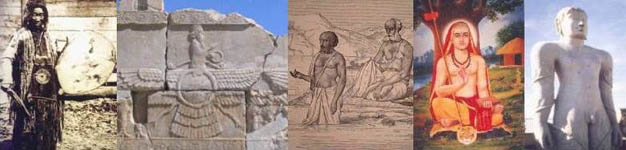
l to r: Siberian shaman, ancient Zoroastrian motif, Hindu brahmans, Shankara, Jaina statue
Minds and Sociocultures Vol. One
Zoroastrianism and the Indian Religions
This complex work has two subtitles, and was originally offered to Routledge in the early 1980s at first draft stage. That [British] publisher turned down the prospect without any inspection of the manuscript, which was never sent to them, being considered too lengthy for commercial interest. The contents subsequently underwent amplification from the author’s accumulating notebooks, and were rewritten in the 1990s, at which time a new introduction was composed. The result was published at Cambridge by Philosophical Press. The lengthy introduction (or Part One), pp. 1-202, has been described as a book in itself. This includes a confrontation with Eliade, Jung, Krishnamurti, Leary, Grof, Aldous Huxley, Ken Wilber, Colin Wilson, and others.
The publisher wished to offer the introduction as a separate work, but the author insisted upon an integral presentation. This adamance made the project more difficult, as very lengthy books were considered a difficult undertaking even by leading university presses. One of the reasons given by the author to the publisher was his objection to popular theories of the “perennial philosophy,” which had abetted the tendency in new age trends to blank out history and archaeology. The objective was to show up discrepancies, and to revive a spirit of due historical analysis. The project involved clearly relates to the history of religion, though the author also frequently refers to sociology. The major bone of contention was the Indian religions, which have been contracted extensively in potted versions. An alternative set of references is here provided, deriving from specialist scholarship. The relatively unpopular Iranian religions are also encompassed.
Published in the UK, 1995, by Philosophical Press.
ISBN-13: 978-0952508908 ISBN-10: 0952508907
996 + xvii pages. 2 maps.
5. Different types of publishing
Academic publishing houses generally produce expensive books, sometimes very markedly in specialist fields of expertise. The commercial publishing houses vary in their standard, some being distinctly non-academic in output. The commercial "giants" dominate retail chain consumption.
What are known as "vanity publishers" gained the reputation of producing books for authors who pay the going rate. Many "vanity" authors are one-off performers in general interest categories such as novels. They are usually forgotten. In contrast, the true self-publisher attends to all stages of the publishing process himself (or herself), and does not pay any publisher to produce their work. There have been markedly different applications, e.g., novelism, history, or other subjects. The survival ability has also varied pronouncedly. Ten years in this sector is considered a long time.
Some self-published books have been discovered to contain factual details difficult to find elsewhere. Subjects varying from the early life of George Orwell to the Findhorn Foundation have gained important profile in such books, which accordingly become reference works. Self-published works with annotations are not common.
Digital printing created a new wave of self-published books. Some of the authors merely wanted a few copies of their work for friends, while others took on the open market with a few hundred copies. In contrast to these were more intensive self-publishers who seriously competed (though on a much smaller scale) with commercial publishers in offset printing, producing quality books in quantities of one thousand and more copies.
Many of the books produced by prominent commercial publishers are often "remaindered" (sold at reduced prices) after two or three years. Academics and major libraries generally have no interest in purely commercial books. In educational terms, there is a big difference between "library shelf" and "commercial shelf" rating. This is not usually understood by general readerships.
To give an example here of my own output. The book entitled Some Philosophical Critiques and Appraisals (2004) was offset printed and published in hardback, using 100gsm paper, and to a scale of 1,500 copies (which is a long run for self-publishing). That book includes over 800 annotations and two indexes. The retail price was low (£15).
I have no further interest or activity in publishing, partly because of the repressive situation created by big business. The book trade is to some extent in chaos. The scenario includes vanishing independent bookshops and online innovations serving to restrict traditional avenues of book-selling.
6. Spells win against critical observations
An increasing drawback, widely noticed in some retail chain bookshops, was the preference for alternative therapy, spells, and related interests. Bookshop buyers in popular occultism tend to opt for books exhibiting a sensational element, popular idiom, and uncritical treatment of materials. This dubious trend is sometimes called "spirituality" or "personal development." Some of the consequences are quite predictable, adding to the general impoverished literary diet of the younger generation. The vogue for spells facilitates a return to medieval superstition.
I remember well an incident which occurred at the Dorchester branch of Ottakars in 2005. This shop promoted the new age magazine Kindred Spirit and displayed several books on love spells, which were evidently considered a commercial attraction. That chain bookshop refused to stock or display my Pointed Observations and the companion work, stating that these were too academic and too "heavy." Serious content was a deterrent in this sector. The same shop was stocking volumes like The Element Encyclopaedia of 5000 Spells (priced at £20, more expensive than the Citizen Initiative books). As a local author, I sent a list of subjects incorporated in Pointed Observations to the managing director of Ottakars headquarters, urging that such pressing issues should be made known and not excluded from the commercial shelves. The subjects listed were as follows:
a) Critique of the excesses of the magician Aleister Crowley, which included vampirism, wife torture, the suggested rape and murder of a young girl, and heroin addiction.
b) Critique of the LSD and related "therapies" of Dr. Stanislav Grof, which have been influential in circles often described as new age. Coverage is included of measures taken by American scientists to cordon the Grofian resuscitation of MDMA therapy, an illegal practice.
c) Critique of the Bhagwan Shree Rajneesh cult who were involved in MDMA use, extreme promiscuity, and terrorism.
d) The crime of Ira Einhorn, a new age superstar who preached love but who brutally murdered his girlfriend, hiding the corpse in a closet, after being glorified by Harvard University.
e) An exposure of the dangers in cocaine use and cannabis use, employing recent research in the face of widespread official and public ignorance about cannabis.
f) AIDS data as detailed by the BBC, though rejected by too many bookshops selling erotic novels, love spells, and other distractions.
g) The alarming spread of violent murders, paedophilism, and juvenile crime as known to the police and the Victims of Crime Trust.
h) Critique of the Findhorn Foundation, a controversial new age community who have promoted, e.g., Aleister Crowley and neoReichian gestalt, while screening out critics of the anomalies (which include a case of alleged child abuse). The Foundation were recently televised by Channel 4 (in 2004), that coverage omitting controversial issues, the media being seriously deficient in this instance.
The Ottakars headquarters responded to the confrontational letter by supporting the action of their Dorchester branch, while denying any ideological bias. The Range Development Manager stated in June 2005: "We will not be placing any orders now; we base this decision on purely commercial grounds." The point to grasp is that purely commercial grounds are the operative factor in book selection and exclusion. There is no due consideration given to education by such components of the book trade, who are accordingly open to strong criticism.
7. Waterstones commercial policy
There are conscientious staff in some bookshops who do feel concerned at the avalanche of decadent literature, the exotic claims of alternative therapy, the spread of magic and witchcraft, and the insidious overture of the drugs lobby. In 2005, I discovered that one of Waterstones branches in a major city recognised the relevance of my Pointed Observations and the companion book Some Philosophical Critiques and Appraisals (2004). That branch actually requested the Waterstones management for an adoption of those books by all branches. The request was vetoed by the commercial policy in operation at this major retail chain. Further enquiry elicited an explanation from the management headquarters that they did not see how they could be expected to work on any other basis than a commercial one. There was no comprehension of an educational role.
Kevin R. D. Shepherd
March 2012 (modified 2020)